
What Dubois County Deeds Record
Every deed accepted by the Dubois County Recorder becomes part of the county's permanent property records. A deed records a conveyance of land. It names the grantor and grantee, and it pins the land down with a legal description. Deeds sit alongside many related instruments in the Recorder's deed records. These include mortgages, releases, assignments, real-estate contracts, plats, surveys, affidavits, liens, and powers of attorney. Those neighbors matter. A deed may transfer ownership while a mortgage still burdens the parcel, or a lien clouds the title. Recording also has a limit worth knowing. It puts an instrument into the public chain of title, but the Recorder does not judge who owns the land or settle competing claims. That work belongs to courts, not the recording counter.
| Deed Type | What It Does | Common Use |
|---|---|---|
| Warranty deed | Conveys the stated real-estate interest with warranties written in the instrument. | Ordinary arm's-length transfer |
| Quitclaim deed | Conveys only the interest the grantor may have, without broader title promises. | Family or ownership cleanup |
| Personal representative deed | Conveys property through an estate representative. | Estate administration |
| Sheriff or tax deed | Records a transfer arising from the process named in the instrument. | Court or tax-sale transfer |
| Affidavit or contract | May explain survivorship, possession, or another interest without serving as a standard sale deed. | Chain clarification |
Labels can mislead, so read the instrument itself. Indexes abbreviate document types. The WTH assessor transfer history relies on short codes that should not be expanded without the recorded image. One deed may cover several parcels or reserve an easement. A release can point back to an older mortgage. The useful unit is the whole linked set: party names, dates, parcel references, legal descriptions, and every related document.
Fidlar Fields for Dubois Deeds
Remote access to Dubois County deed records runs through the Fidlar Tapestry EON login. That is the public route tied to the Recorder's office. A property search there can start from a party name. It can also start from an identifying feature of the instrument. For heavier use, the Recorder offers Laredo, a subscription alternative. Neither service publishes a Dubois-specific earliest online index year. So an empty result does not prove a deed was never recorded. Older instruments may simply sit outside the remote index.
| Search field | Useful entry | Search note |
|---|---|---|
| Party | First name and last or business name | Try the exact entity and name variants |
| Instrument | Document number or document type | Best when a WTH transfer row supplies the number |
| Date | Beginning and ending recording dates | Use a wider span when timing is uncertain |
| Land key | Parcel, subdivision, lot, block, or metes and bounds | Guards against same-name matches |
The vendor interface also exposes a consideration field and a percent wildcard for looser matching. A result can carry plenty of detail. It lists document number, recorded date, type, associated documents, grantors, parcel number, consideration, subdivision or metes-and-bounds text, and an image link. Expect possible charges for both searching and image access. The official Dubois County Tapestry entry screen is the remote doorway to the Recorder's recorded documents.
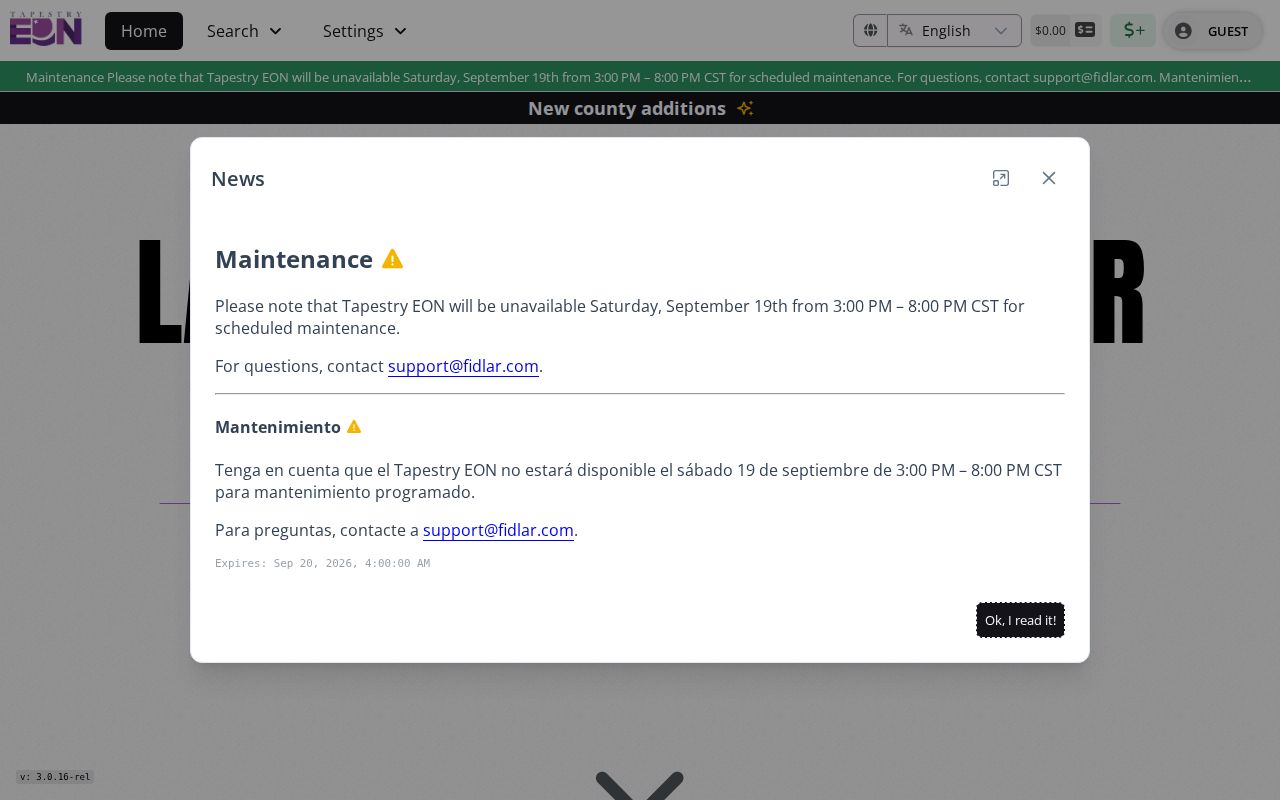
Treat that screen as a doorway into the index rather than a local result. Confirm every hit against the indexed parties and the legal description before trusting it.
Free Counter or Paid Search
There are two different paths to the same deed records. You can walk into the courthouse. Or you can search from home. At the public counter, the Dubois County Recorder lets anyone search for free, Monday through Friday from 8 a.m. to 4 p.m. Eastern. Remote access costs money. Tapestry charges $8.95 per search plus $1 per image page. Laredo runs on subscription minute plans the county lists. Someone tracing several linked deeds may save by using the counter; a single known instrument number may be quicker online.
Whichever route you choose, arrive prepared. Bring the state parcel number, local parcel number, tax-routing key, situs address, owner names, and the exact legal description. These keys cut down false matches and let staff point you to the right records fast. Staff will not run a title search for you. For mailed requests, identify the instrument clearly. Confirm the current copy or certification charge before sending payment.
Note: Counter searching is free, but copies, certifications, remote searches, and online images each carry separate charges.
Dubois County Grantor-Grantee Chain
A grantor gives up an interest; a grantee takes it. The grantor-grantee index turns those pairs into a working chain of title, the ordered run of instruments tied to one piece of land. Names alone will mislead you. Anchor every step to the legal description, parcel clues, document number, and any related filings.
- Start with the latest owner from WTH and search that name as a grantee. If WTH supplies a document number, try it first.
- Open the matching deed and record its grantor, grantee, recording date, legal description, and document reference.
- Search the grantor as an earlier grantee. Confirm that the land description still follows the same parcel through any split or combination.
- Repeat until the remote index stops, then continue with deed books, grantor and grantee indexes, or microfilm.
- Grantor
- The party who transfers the stated interest.
- Grantee
- The party who receives the stated interest.
- Chain of title
- The linked sequence of conveyances affecting the same land.
- Book/page and instrument number
- Older and newer ways to cite a recorded document precisely.
The 1839 Record Break
A courthouse fire in 1839 wiped out nearly every earlier Dubois County record. Any long deed chain eventually hits that wall. The Indiana State Library microfilm finding aid catalogs deed records and grantor-grantee indexes covering 1839 through 1923. Those films, the Recorder's own deed books, and later deeds reciting an older interest are the sound fallback. They carry the search when online deed records run out.
Before the fire, a search needs a bridge, not a guessed owner. Mine later recitals and re-recorded papers. Use old tax lists, plat books, newspapers, county histories, and federal land context. Tag every item as an original record, index, abstract, or later recital. That label keeps a historic clue from passing itself off as a full title link.
Dubois Plat and Survey Links
A deed's legal description usually points to a plat or survey. That drawing is often the fastest way to make sense of the wording. The Dubois County Recorder keeps plats, surveys, easements, and planned development records. It links a Transfer and Plat Books portal as well. Start with the deed itself. Copy the subdivision, lot, block, section, township, range, or metes-and-bounds text exactly. Then carry that phrasing straight into a plat search.
The State Library Dubois map and plat guide covers Dubois County plat books from 1925 through 1941. It also lists many later city and county directories. Old maps explain streets and lot labels that have shifted over time. Still, they support rather than replace a recorded legal description or a survey.
Post-2025 Index Changes
A vendor notice reports that Doxpop stopped covering newly recorded Dubois County documents. The cutoff date was November 18, 2025. That cutoff matters. A failed Doxpop search for a later transfer proves nothing about whether a deed exists. For anything recorded after that date, rely on the Recorder's current Fidlar routes. You can also go to the courthouse counter. This is especially true when a recent conveyance already shows up on an assessor card or appears in closing papers.
Dubois County publishes no fixed delay between a recording and the matching assessor-card update. So keep the two calendars apart. The recorded index is where the legal event lives. WTH serves as the tax-roll view. Separating those dates keeps a routine update lag from looking like a genuine gap in the deed records.
Fraud Alerts and Dubois Deeds
The Recorder links to Property Fraud Alert enrollment. It sends notices when recorded activity matches a subscriber's watch terms. The county page makes no promise that every filing type triggers a notice. Treat any alert as a prompt, not a verdict. It tells you to look at the official instrument, which is where validity gets decided.
The Dubois County alert enrollment screen is the Recorder-linked entry point for signing up.
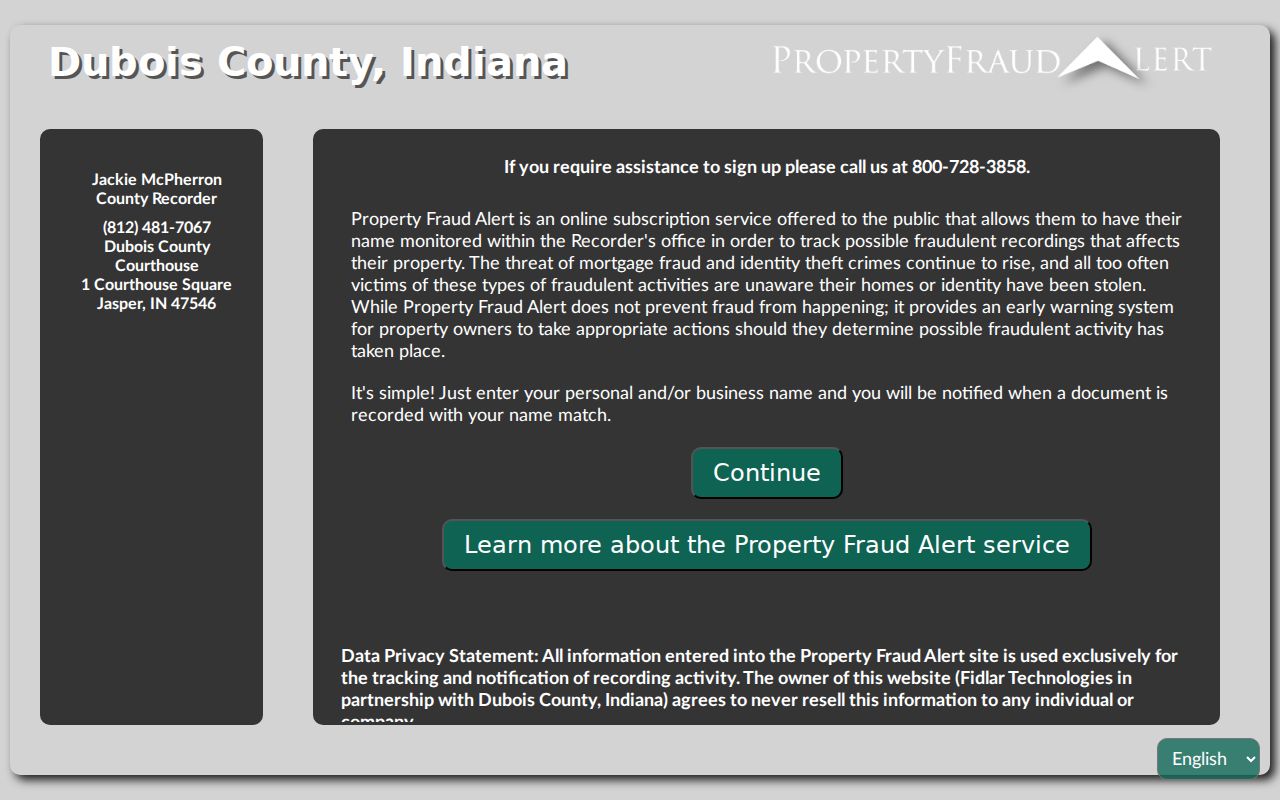
An alert means one thing: go check. The official index and the instrument itself hold the answers. Parties, recording date, parcel reference, and legal description can all be verified there.
A 2025 local scam report described a fake tax-investigation and lien letter demanding $7,599.60. The safe response is simple. Verify the supposed filing with the Recorder or Treasurer using official contact details. Never pay based on a letter's instructions alone. And do not mistake a threatening mailing for a recorded lien. The two are entirely different things in Dubois County records.
Obtain a Dubois County Deed
Once the deed is identified, pick the copy that fits the job. A remote image works for research. A plain counter copy suits ordinary reading. A certified copy carries the Recorder's certification. It may be required for a formal filing or proceeding. So ask the Recorder which form you need and confirm the current fee. For older material, cite the deed book and page from the index. You can also use the State Library finding aid.
When an online search cannot be completed, there are other routes. Visit the counter. Send a focused request. You can also use the State Library and State Archives routes for historic holdings. Include names, a date range, document number, parcel identifiers, and the legal description. Indiana's Access to Public Records Act, Ind. Code § 5-14-3, backs requests for identifiable public records. It does not, however, force an office to build a new title history from scratch.
Recorded, not guaranteed. Dubois County deed records show accepted filings. They do not establish that no unrecorded interest, defect, or competing claim exists.